Books by splitShops
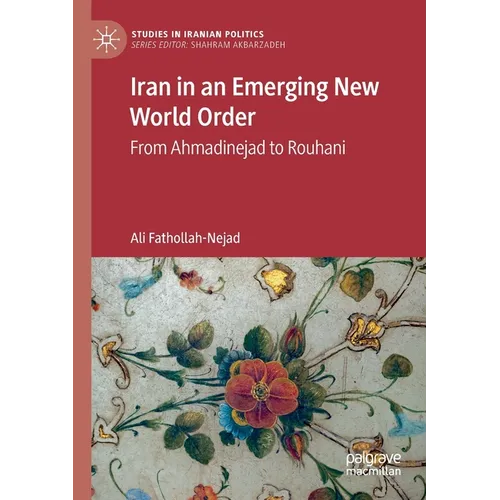
Iran in an Emerging New World Order: From Ahmadinejad to Rouhani - Paperback
Iran in an Emerging New World Order: From Ahmadinejad to Rouhani - Paperback
Couldn't load pickup availability
by Ali Fathollah-Nejad (Author)
This book critically develops and discusses Iran's geopolitical imaginations and explores its various foreign-policy schools of thought and their controversies. In doing so, the book covers Iran's foreign policy and international relations from "9/11" all the way to Rouhani's rise (late 2014).
Accounting for both domestic and the international balance of power, the book theorizes the post-unipolar world order of the 2000s, dubbed "imperial interpolarity", examines Iran's relations with non-Western great-powers in that era, and offers a critique of the "Rouhani doctrine" and its economic and foreign-policy visions.
Forged in the fires and intense deliberations of a PhD, undertaken at a most unique institution of higher learning in the world, Ali Fathollah-Nejad has produced one of the most informative and evocative studies of Iran's foreign policy and international relations to date. Framed in a highly original theoretical approach, Ali's nuanced analysis, drawing on a lorry load of primary and secondary sources, details the process and context of policy in the Islamic Republic, thus producing an unrivalled and lasting account of modern Iran's worldview and the behaviour of this revolutionary state in a fast-changing world.
--Anoush Ehteshami, Professor of International Relations & Director of the Institute for Middle Eastern and Islamic Studies, School of Government and International Affairs, Durham University (UK)
Empirically rich and theoretically sophisticated, Iran in an Emerging New World Order flashes out the key drivers behind Iran's international relations since the mid-2000s. Providing evidence for the material and geopolitical significance of Iran's identity constructions, the book enriches the debate on the Islamic Republic's foreign policy and bridges the divide between the discipline of IR and area studies.--Fawaz A. Gerges, Professor of International Relations & inaugural Director, LSE Middle East Centre (2010-13), London School of Economics and Political Science (LSE); author of the forthcoming The 100 Years' War for Control of the Middle East (Princeton University Press, 2021).
Ali Fathollah-Nejad has established himself as one of the most insightful observers of Iranian politics. Providing the analytical background to his assessments of Tehran's foreign policy in the 21st century, this book comes out opportunely at a time when a new U.S. administration is about to re-engage with Iran.
--Gilbert Achcar, Professor of Development Studies and International Relations, SOAS (School of Oriental and African Studies) University of LondonA decisive contribution to two avant-gardist fields of knowledge: Critical geopolitics and Iranian foreign relations. Anyone interested in cutting-edge research that brings together International Relations and Iranian Studies will revel in this important book.
--Arshin Adib-Moghaddam, Professor in Global Thought and Comparative Philosophies, Department of Politics and International Studies & former Chair (2012-18), Centre for Iranian Studies, SOAS University of London
One of the few to have a thorough, beyond-the-headlines and forward-looking grasp of Iran, Ali Fathollah-Nejad offers a brilliant analysis of what is in store for Iran. A must-read for anybody interested in geopolitics.--Florence Gaub, Deputy Director & Director of Research, European Union Institute for Security Studies (EUISS), Paris
It is no longer possible to think of any nation-state without simultaneously seeing the reflection of an entire changing world in it. Ali Fathollah-Nejad's prose and politics in Iran in an Emerging New World Order is the state-of-the-art mapping of the epistemic shift that seeks to understand the global in the local, and the domestic in the foreign. The result is a mode of supple and symbiotic thinking that reveals the way transnational politics dwells on the borderline where the fate of nations unravels into the fold of a dysfunctional disorder that has become the fact of our fragile world.--Hamid Dabashi, Hagop Kevorkian Professor of Iranian Studies and Comparative Literature, Columbia University
Iranian politics, outside of a small group of specialists, remains poorly understood. Iran in an Emerging New World Order helps demystify this subject. Thoroughly researched, very accessible and packed with insights, this book, focusing on the Ahmadinejad period, is highly recommended. It makes an important contribution to the study of internal Iranian politics, Iran's foreign policy orientation and the international relations of the Middle East.
--Nader Hashemi, Director, Center for Middle East Studies & Associate Professor, Josef Korbel School of International Studies, University of DenverAli Fathollah-Nejad has produced an academic work that is, from my viewpoint, so far the most comprehensive one concerning Iranian standing in regional and international politics, its new political élite and their attitude towards the West and the world order.
--Farhad Khosrokhavar, Professor in the Sociology of Contemporary Iran & Director of Studies at EHESS (École des hautes études en sciences sociales), the School for Advanced Studies in the Social Sciences, France
Since its inception in 1979, the Islamic Republic's initial foreign policy was based on the rejection of the bipolar international order under the banner of a "neither East nor West" policy. By the end of the Cold War and the emergence of a unipolar order, the Islamic Republic tried to adjust its approach to deal with the United States as a hegemonic power. Iran shifted its foreign policy toward the East as soon as the international order moved from unipolarity in the early 2000s. Why did Iran turn its foreign policy, and what were the consequences and ramifications of this shift? Iran in an Emerging New World Order dives deep to answerBack Jacket
This book critically develops and discusses Iran's geopolitical imaginations and explores its various foreign-policy schools of thought and their controversies. Accounting for both domestic and the international balance of power, the book theorizes the post-unipolar world order of the 2000s, dubbed "imperial interpolarity", examines Iran's relations with non-Western great-powers in that era, and offers a critique of the "Rouhani doctrine" and its economic and foreign-policy visions.
Ali Fathollah-Nejad is Senior Lecturer in Middle East and Comparative Politics at the University of Tübingen's Institute of Political Science, where he is also Coordinator of the joint Master's program with the American University in Cairo (AUC). He is also a Nonresident Fellow at the Brookings Institution's Center for Middle East Policy (CMEP), following his Visiting Fellowship at the Brookings Doha Center. He holds a PhD in International Relations from the Department of Development Studies at SOAS (School of Oriental and African Studies, University of London) and was a post-doctoral Associate with the Harvard Kennedy School's Iran Project.
Author Biography
Ali Fathollah-Nejad is a German-Iranian political scientist focusing on Iran, the Middle East, and the post-unipolar world order. He holds a Ph.D. in International Relations from the Department of Development Studies at SOAS (School of Oriental and African Studies, University of London) and was the winner of 2016/17 post-doctoral fellowship of the Harvard Kennedy School's Iran Project. He is an affiliated researcher with the Centre d'Études de la Coopération Internationale et du Développement (CECID) at Université libre de Bruxelles (ULB), Freie Universität (FU) Berlin's Center for Middle Eastern and North African Politics and the Afro-Middle East Centre (AMEC), South Africa's think-tank specialized on the Middle East. Most recently, he was Senior Lecturer in Middle East and Comparative Politics at the University of Tübingen and adjunct Assistant Professor in the Ph.D. program of Qatar University's Gulf Studies Center. Ali is also the former Iran expert of the Brookings Institution inDoha (BDC, 2017-20) and the German Council on Foreign Relations (DGAP, 2015-18). In 2020, he published two monographs: The Islamic Republic of Iran Four Decades On: The 2017/18 Protests Amid a Triple Crisis and The Politics of Culture in Times of Rapprochement: European Cultural and Academic Exchange with Iran (2015-16).
Share