Books by splitShops
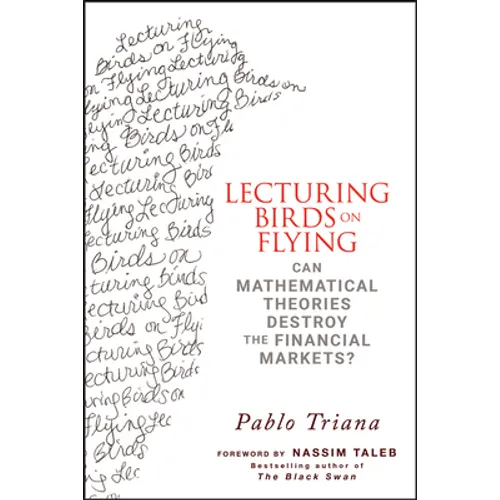
Lecturing Birds on Flying: Can Mathematical Theories Destroy the Financial Markets? - Hardcover
Lecturing Birds on Flying: Can Mathematical Theories Destroy the Financial Markets? - Hardcover
Couldn't load pickup availability
by Pablo Triana (Author), Nassim Nicholas Taleb (Foreword by)
Führende Finanzexperten diskutieren, auch konvers, seit Jahren über den Konflikt zwischen Theorie und Praxis. Als einer der ersten befasste sich Nassim Taleb in seinem, eher für Finanzexperten geschriebenen Buch "Dynamic Hedging" mit diesem Problem. Pablo Triana bereitet in "Lecturing Birds on Flying" das Thema nun für Laien verständlich auf und erläutert, warum Finanztheorien in der Praxis oftmals jegliche Relevanz verlieren. Dabei geht er nicht auf finanztechnische Details ein, sondern zeigt, dass allgemein anerkannte und täglich angewandte Theorien für unsere Wirtschaftswelt schädlich sein können. Sehr oft führen quantitative Modelle, mit denen Hedge Fonds und Investmentbanken (aber auch Regulierungsbehörden und Rating-Agenturen) arbeiten zu einem Zusammenbruch des Marktes. Diese sogenannten Modelle führen zu falschen Entscheidungen, wiegen Investoren in falscher Sicherheit und sanktionieren eher fragwürdige Verhaltensweisen. So waren diese Modelle ma geblich für den Börsencrash des Jahres 1987, die LTCM-Pleite 1998, die Kreditkrise 2008 und viele andere grö ere oder kleinere Crashs verantwortlich. Seit Jahren schreibt Pablo Triana über die Grenzen dieser Art mathematischer Berechnungen und zeigt nun, welche Konsequenzen dieser Ansatz für unsere Märkte hat und warum das blinde Vertrauen auf quantitative Maximen eine gro e Gefahr in sich birgt.
Front Jacket
For the past few decades, the financial world has often displayed an unreasonable willingness to believe that "the model is right, the market is wrong," in spite of the fact that these theoretical machinations were largely responsible for the stock market crash of 1987, the LTCM crisis of 1998, the credit crisis of 2008, and many other blow-ups, large and small. Why have both financial insiders (traders, risk managers, executives) and outsiders (academics, journalists, regulators, the public) consistently demonstrated a willingness to treat quantifications as gospel? Nassim Taleb first addressed the conflicts between theoretical and real finance in his technical treatise on options, Dynamic Hedging. Now, in Lecturing Birds on Flying, Pablo Triana offers a powerful indictment on the trustworthiness of financial theory, explaining-in jargon-free plain English-how malfunctions in these quantitative machines have wreaked havoc in our real world.
Triana first analyzes the fundamental question of whether financial markets can in principle really be solved mathematically. He shows that the markets indeed cannot be tamed with equations, presenting a long and powerful list of obstacles to prove his point: maverick unlawful human actions rule the markets, unexpected and unimaginable events shape the markets, and historical data is not necessarily a trustworthy guide to the future of the markets. The author then examines the sources of origin of many prevalent theories and mathematical dictums. He details how the field of financial economics evolved from a descriptive discipline to an abstract one dedicated to technically concocting professors' own versions of how such a world should work. He goes on to explain how Wall Street and other financial centers became eager employers of scientists, and how scientists became eager employees of financial firms. Triana concludes with an in-depth discussion of the most significant historical episodes of theory-caused real-life market malaise, with a strong emphasis on the current credit crisis.
In the end, Lecturing Birds on Flying calls for the radical substitution of good old-fashioned common sense in place of mathematical decision-making and the restoration to financial power of those who are completely unchained to the iron ball of classroom-obtained qualifications.
Back Jacket
LECTURING BIRDS ON FLYING
For the past few decades, the financial world has often displayed an unreasonable willingness to believe that "the model is right, the market is wrong," in spite of the fact that these theoretical machinations were largely responsible for the stock market crash of 1987, the LTCM crisis of 1998, the credit crisis of 2008, and many other blow-ups, large and small. Why have both financial insiders (traders, risk managers, executives) and outsiders (academics, journalists, regulators, the public) consistently demonstrated a willingness to treat quantifications as gospel? Nassim Taleb first addressed the conflicts between theoretical and real finance in his technical treatise on options, Dynamic Hedging. Now, in Lecturing Birds on Flying, Pablo Triana offers a powerful indictment on the trustworthiness of financial theory, explaining--in jargon-free plain English--how malfunctions in these quantitative machines have wreaked havoc in our real world.
Triana first analyzes the fundamental question of whether financial markets can in principle really be solved mathematically. He shows that the markets indeed cannot be tamed with equations, presenting a long and powerful list of obstacles to prove his point: maverick unlawful human actions rule the markets, unexpected and unimaginable events shape the markets, and historical data is not necessarily a trustworthy guide to the future of the markets. The author then examines the sources of origin of many prevalent theories and mathematical dictums. He details how the field of financial economics evolved from a descriptive discipline to an abstract one dedicated to technically concocting professors' own versions of how such a world should work. He goes on to explain how Wall Street and other financial centers became eager employers of scientists, and how scientists became eager employees of financial firms. Triana concludes with an in-depth discussion of the most significant historical episodes of theory-caused real-life market malaise, with a strong emphasis on the current credit crisis.
In the end, Lecturing Birds on Flying calls for the radical substitution of good old-fashioned common sense in place of mathematical decision-making and the restoration to financial power of those who are completely unchained to the iron ball of classroom-obtained qualifications.
Author Biography
PABLO TRIANA has successful derivatives ex-perience at all levels: on the trading floor and as a professor, consultant, and author. He is a frequent contributor to business publications, including the Financial Times, Forbes.com, Breakingviews.com, and Risk magazine, among others. Triana is also the author of Corporate Derivatives. He holds a master of science from the Stern School of Business, New York University, and a master of arts from American University.
Share