Books by splitShops
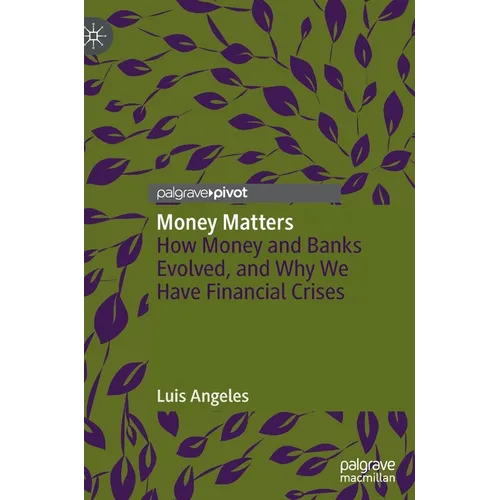
Money Matters: How Money and Banks Evolved, and Why We Have Financial Crises - Hardcover
Money Matters: How Money and Banks Evolved, and Why We Have Financial Crises - Hardcover
Couldn't load pickup availability
by Luis Angeles (Author)
This book explores the nature of money and banking throughout their history, and applies this to the study of financial crises. The first part of the book covers the evolution of monetary arrangements, money creation and the business of banking since their earliest manifestations to the present day, showing how changes in the business of banking led to a transformation in the money we use. The second part of the book applies the understanding acquired during the first part to the study of financial crises, showing that money is taken out of circulation when bank loans are paid back. This key insight is at the core of the mechanism that explains financial crises, since an economy that sees its money supply diminish is also an economy that cannot generate enough demand for its own goods and services. Financial crises result when bank lending slows down or comes to a halt - while outstanding bank loans are still due for repayment. The mechanism is discussed in detail, and the crucial role of banks highlighted. Adequate policy measures to prevent crises, or to mitigate their effects, are then put forward in light of this mechanism. The book will be of interest to researchers and students of economic and financial history, as well as those working in finance, banking and economics more widely.
Back Jacket
This book explores the nature of money and banking throughout their history, and applies this to the study of financial crises. The first part of the book covers the evolution of monetary arrangements, money creation and the business of banking since their earliest manifestations to the present day, showing how changes in the business of banking led to a transformation in the money we use. The second part of the book applies the understanding acquired during the first part to the study of financial crises, showing that money is taken out of circulation when bank loans are paid back. This key insight is at the core of the mechanism that explains financial crises, since an economy that sees its money supply diminish is also an economy that cannot generate enough demand for its own goods and services. Financial crises result when bank lending slows down or comes to a halt - while outstanding bank loans are still due for repayment. The mechanism is discussed in detail, and the crucial role of banks highlighted. Adequate policy measures to prevent crises, or to mitigate their effects, are then put forward in light of this mechanism. The book will be of interest to researchers and students of economic and financial history, as well as those working in finance, banking and economics more widely.
Luis Angeles is Professor of Economics at the Adam Smith Business School of the University of Glasgow, United Kingdom. He has published work in economic history, economic development, and banking and financial topics. His work has appeared in academic journals such as the Economic History Review, Explorations in Economic History, the Journal of Development Economics, the European Economic Review, Economica, Kyklos, and more.Author Biography
Luis Angeles is Professor of Economics at the Adam Smith Business School of the University of Glasgow, United Kingdom. He has published work in economic history, economic development, and banking and financial topics. His work has appeared in academic journals such as the Economic History Review, Explorations in Economic History, the Journal of Development Economics, the European Economic Review, Economica, Kyklos, and more.
Share