1
/
of
1
Books by splitShops
Proscribing Peace: How Listing Armed Groups as Terrorists Hurts Negotiations - Paperback
Proscribing Peace: How Listing Armed Groups as Terrorists Hurts Negotiations - Paperback
Regular price
$51.72 USD
Regular price
Sale price
$51.72 USD
Shipping calculated at checkout.
Quantity
Couldn't load pickup availability
by Sophie Haspeslagh (Author)
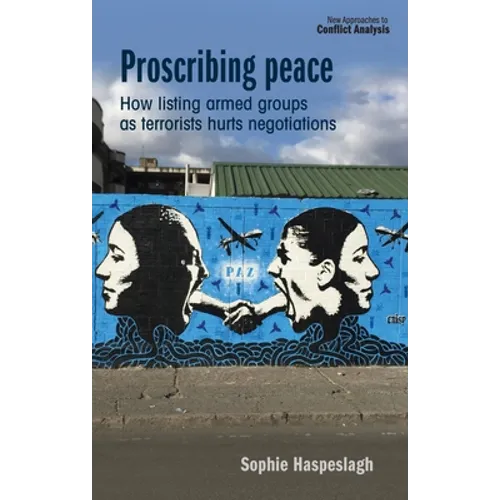
Proscribing peace offers a systematic examination of the impact of proscription on peace negotiations.
By introducing the concept of 'linguistic ceasefire', Haspeslagh adds to our understanding of the timing and sequencing of peace processes in the context of proscription. With relevance for more than half of the conflicts around the world in which an armed group is listed as a terrorist organisation, 'linguistic ceasefire' helps to explain why certain conflicts remain stuck in the 'terrorist' framing, while others emerge from it. International proscription regimes criminalise both the actor and the act of terrorism. Proscribing peace calls for an end to the amalgamation between acts and actors. By focussing on the acts instead, Haspeslagh argues, international policy would be better able to consider the violent actions both of armed groups and those of the state. By separating the act and the actor, change - and thus peace - become possible.Back Jacket
'An exciting story and a penetrating analysis.'
I. William Zartman, Johns Hopkins University
Roger Mac Ginty, Durham University 'A really important read for social scientists and peace practitioners.'
Jenny Pearce, Latin America and Caribbean Centre, London School of Economics 'A compelling argument for a more rational approach to proscription in the context of peace talks, and essential reading as we approach the 20th anniversary of 9/11.'
Jonathan Powell, CEO and Founder, Inter Mediate Proscribing peace offers a systematic examination of the impact of proscription on peace negotiations. With rare access to actors during the Colombian negotiations with the Revolutionary Armed Forces of Colombia People's Army (FARC), Sophie Haspeslagh shows how proscription makes negotiations harder and more prolonged. By introducing the concept of 'linguistic ceasefire', Haspeslagh adds to our understanding of the timing and sequencing of peace processes in the context of proscription. Linguistic ceasefire has three main components: first, recognise the conflict; second, discard the 'terrorist' label, and third, uncouple the act and the actor. These measures remove the symbolic impact of proscription, even where de-listing is not possible ahead of negotiations. With relevance for more than half of the conflicts around the world in which an armed group is listed as a terrorist organisation, 'linguistic ceasefire' helps to explain why certain conflicts remain stuck in the 'terrorist' framing, while others emerge from it. International proscription regimes criminalise both the actor and the act of terrorism. Proscribing peace calls for an end to the amalgamation between acts and actors. By focussing on the acts instead, Haspeslagh argues, international policy would be better able to consider the violent actions both of armed groups and those of the state. By separating the act and the actor, change - and thus peace - become possible.
Author Biography
Sophie Haspeslagh is Lecturer in the Department of War Studies, King's College London
Number of Pages: 240
Dimensions: 0.51 x 9.21 x 6.14 IN
Illustrated: Yes
Publication Date: March 07, 2023
Share