Books by splitShops
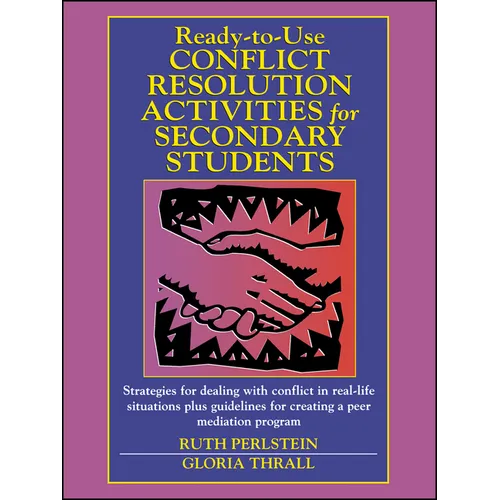
Ready-To-Use Conflict Resolution Activities for Secondary Students - Paperback
Ready-To-Use Conflict Resolution Activities for Secondary Students - Paperback
Couldn't load pickup availability
by Ruth Perlstein (Author), Gloria Thrall (Author)
This practical resource gives counselors, coaches, and youth leaders a program for training secondary students in conflict resolution and peer mediation. Activities use typical adolescent scenarios and role-plays with reproducible handouts to make the skills involved in resolving conflicts relevant and accessible to students of all ability levels.
Front Jacket
For counselors, teachers, or anyone else working with teenagers, this practical resource provides more than 90 ready-to-use lessons for teaching peaceful and successful ways of resolving conflict, including activities with typical adolescent scenarios and nearly 150 reproducible role-plays.
For easy use, these materials are conveniently organized into three parts and printed in a large 8-1/4 x 11 lay-flat binding that opens flat for easy photocopying as many times as needed.
PART I covers the basic concepts of conflict resolution. Here's just a sampling of activities and accompanying handouts you?ll find in each of the seven sections:
- Defining Conflict: Identifying the problem and underlying needs of two parties? Homework From the New Student?The Brothers? Car
- Different Kinds of Conflict: Four types of conflict?inner, interpersonal, intra-personal, and inter-group?Identifying the Conflict Within a Class
- Dealing with Conflict: Conflict management styles...Which Style Will Work?
- Understanding Different Points of View: Viewing situations differently? Looking Through Our Own Glasses
- Communicating: Open-ended questions, paraphrasing, toning down language, ?I? statements, and more, to defuse anger in others?Reading Non-Verbal Cues?Noticing Mixed Messages
- Collaborative Problem Solving: The process of defining, brainstorming, and choosing alternatives? Cooperation vs. Competition
- Mediating: Techniques of involving a third party, identifying interests, and mediating with a group?Dora Spills the Beans?Quarrel with the Quarterback
- Conflict in the Counselor's Office: A seven-step process for mediating a dispute between two parties, distinguishing mediation from counseling?Two Chairs?From the Other Chair
- Conflict Resolution in the Classroom: Teaching the concepts in academic classes?Yugoslavia and China?King Lear's Problems
- Conflict Resolution in Extra-Curricular Activities: Practice in settling conflicts?Dealing with a Difficult Colleague? Encouraging Nonviolence
In short, this unique resource gives you a complete program for helping students develop the conflict management skills they will need and use long after they have left your classroom!
Back Jacket
For counselors, teachers, or anyone else working with teenagers, this practical resource provides more than 90 ready-to-use lessons for teaching peaceful and successful ways of resolving conflict, including activities with typical adolescent scenarios and nearly 150 reproducible role-plays.
For easy use, these materials are conveniently organized into three parts and printed in a large 8-1/4" x 11" lay-flat binding that opens flat for easy photocopying as many times as needed.
PART I covers the basic concepts of conflict resolution. Here's just a sampling of activities and accompanying handouts you?ll find in each of the seven sections:
- Defining Conflict: Identifying the problem and underlying needs of two parties? Homework From the New Student?The Brothers? Car
- Different Kinds of Conflict: Four types of conflict?inner, interpersonal, intra-personal, and inter-group?Identifying the Conflict Within a Class
- Dealing with Conflict: Conflict management styles...Which Style Will Work?
- Understanding Different Points of View: Viewing situations differently? Looking Through Our Own Glasses
- Communicating: Open-ended questions, paraphrasing, toning down language, ?I? statements, and more, to defuse anger in others?Reading Non-Verbal Cues?Noticing Mixed Messages
- Collaborative Problem Solving: The process of defining, brainstorming, and choosing alternatives? Cooperation vs. Competition
- Mediating: Techniques of involving a third party, identifying interests, and mediating with a group?Dora Spills the Beans?Quarrel with the Quarterback
- Conflict in the Counselor's Office: A seven-step process for mediating a dispute between two parties, distinguishing mediation from counseling?Two Chairs?From the Other Chair
- Conflict Resolution in the Classroom: Teaching the concepts in academic classes?Yugoslavia and China?King Lear's Problems
- Conflict Resolution in Extra-Curricular Activities: Practice in settling conflicts?Dealing with a Difficult Colleague? Encouraging Nonviolence
In short, this unique resource gives you a complete program for helping students develop the conflict management skills they will need and use long after they have left your classroom!
Author Biography
Ruth Perlstein has counseled students for over 25 years at West Potomac High School in Fairfax County (VA), where she organized the peer mediation program.
Gloria Thrall has over 20 years of experience teaching English, reading, and social studies, and is currently a counselor at West Potomac High School, where she has worked with at-risk students, sponsored a mentoring program, and coordinates the peer mediation program.
Share