Books by splitShops
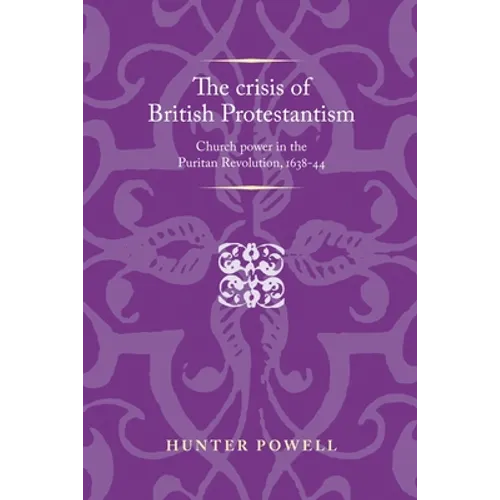
The Crisis of British Protestantism: Church Power in the Puritan Revolution, 1638-44 - Paperback
The Crisis of British Protestantism: Church Power in the Puritan Revolution, 1638-44 - Paperback
Couldn't load pickup availability
by Hunter Powell (Author)
This book seeks to bring coherence to two of the most studied periods in British history, Caroline non-conformity (pre-1640) and the British revolution (post-1642). It does so by focusing on the pivotal years of 1638-44 where debates around non-conformity within the Church of England morphed into a revolution between Parliament and its king. Parliament, saddled with the responsibility of re-defining England's church, called its Westminster assembly of divines to debate and define the content and boundaries of that new church. Typically this period has been studied as either an ecclesiastical power struggle between Presbyterians and independents, or as the harbinger of modern religious toleration. This book challenges those assumptions and provides an entirely new framework for understanding one of the most important moments in British history.
Front Jacket
This book straddles a crucial divide in British history, as calls for religious reform and renewal mutated into political revolution. It seeks to bring coherence to a pre-revolutionary historiography that focuses on questions of conformity to and (semi-)separatism from 'the church by law established' and a post-1642 historiography built around a coarse polarity of 'Presbyterian' and 'Independent', and modern notions of religious toleration. This book argues that the fundamental ecclesiological issue in 1638-44 was the question of church power. Once Parliament conceded that ecclesiastical power did not reside in the diocesan bishop, the state, along with its leading puritan divines, needed to isolate where church power existed and how that power was executed. Parliament wanted a church that would stymie a clerical usurpation of state control, but could equally fend off the burgeoning call for separation of church and state. When Parliament called the Westminster assembly of divines, it knew that one of the most destabilising elements of the body politic was an inchoate national church, where heterodoxy presented as much of a threat as prelacy. This book rigorously examines this pivotal moment of religious reform by analysing a small but vitally important group of these assembly divines, their writings, and their private interaction as Parliament began national church reform in the midst of a civil war. It challenges many long-held assumptions surrounding religious and political debates during the Puritan Revolution and will provide a new framework for both students and teachers to understand one of the most important moments in British history.
Back Jacket
This book straddles a crucial divide in British history, as calls for religious reform and renewal mutated into political revolution. It seeks to bring coherence to a pre-revolutionary historiography that focuses on questions of conformity to and (semi-)separatism from 'the church by law established' and a post-1642 historiography built around a coarse polarity of 'Presbyterian' and 'Independent', and modern notions of religious toleration.
This book argues that the fundamental ecclesiological issue in 1638-44 was the question of church power. Once Parliament conceded that ecclesiastical power did not reside in the diocesan bishop, the state, along with its leading puritan divines, needed to isolate where church power existed and how that power was executed. Parliament wanted a church that would stymie a clerical usurpation of state control, but could equally fend off the burgeoning call for separation of church and state. When Parliament called the Westminster assembly of divines, it knew that one of the most destabilising elements of the body politic was an inchoate national church, where heterodoxy presented as much of a threat as prelacy. This book rigorously examines this pivotal moment of religious reform by analysing a small but vitally important group of these assembly divines, their writings, and their private interaction as Parliament began national church reform in the midst of a civil war. It challenges many long-held assumptions surrounding religious and political debates during the Puritan Revolution and will provide a new framework for both students and teachers to understand one of the most important moments in British history.Author Biography
Hunter Powell is an Independent Scholar
Share