Books by splitShops
The Universal Baroque - Paperback
The Universal Baroque - Paperback
Couldn't load pickup availability
by Peter Davidson (Author)
'The nation-state is the enemy of the baroque.' This is the point of departure of this radical, even revolutionary, re-examination of the cultural history of the early-modern world. Drawing on sources in six languages, many of them hitherto unavailable to the English-speaking reader, and touching on the visual arts, architecture, music and literature, this study frees the word 'baroque' from being a term of periodisation into being the descriptor for a network of circulation of ideas, words, plants, arts and energies which encompassed the totality of the early-modern world.
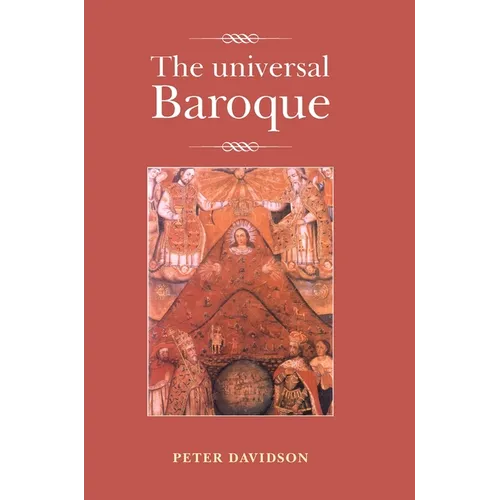
This challenging book also forces a reconsideration of many of the prejudices of the Anglophone perception of cultural history and in doing so opens to the reader a world of wonders: the allegorical dramas of Ireland and Belgrade; the arquebusier angels of Cuzco painting; the operas and festival music of Bolivia; the vertiginous architectural fantasies of the Jacobite exiles.Front Jacket
'The nation-state is the enemy of the baroque.' This is the point of departure of this radical, even revolutionary, re-examination of the cultural history of the early-modern world. Drawing on sources in six languages, many of them hitherto unavailable to the English-speaking reader, and touching on the visual arts, architecture, music and literature, this study frees the word 'baroque' from being a term of periodisation (and too often, in English, a term of suspicion and denial) into being the descriptor for a network of circulation of ideas, words, plants, arts and energies which encompassed the totality of the early-modern world. This new mapping offers the hybridity of the arts of Ibero-America, the fruitful combination of the local and the international, as a way of re-examining the arts of the British Isles and Ireland, particularly the little-known Latinate high culture of seventeenth century Ireland and Scotland. It challenges also the anachronistic imposition of the modern idea of 'capitals of culture' on to the early-modern world, whose international culture fused the local and the international to the degree that remote settlements in Peru and Bolivia, a castle in Aberdeenshire, or an Episcopal Palace in what is now Serbia functioned as cultural centres as important as Madrid or London. This challenging book forces a reconsideration of many of the prejudices of the Anglophone perception of cultural history and in doing so opens to the reader a world of wonders: the allegorical dramas of Ireland and Belgrade; the arquebusier angels of Cuzco painting; the operas and festival music of Bolivia; the vertiginous architectural fantasies of the Jacobite exiles.
Back Jacket
'The nation-state is the enemy of the baroque.' This is the point of departure of this radical, even revolutionary, re-examination of the cultural history of the early-modern world. Drawing on sources in six languages, many of them hitherto unavailable to the English-speaking reader, and touching on the visual arts, architecture, music and literature, this study frees the word 'baroque' from being a term of periodisation (and too often, in English, a term of suspicion and denial) into being the descriptor for a network of circulation of ideas, words, plants, arts and energies which encompassed the totality of the early-modern world.
This new mapping offers the hybridity of the arts of Ibero-America, the fruitful combination of the local and the international, as a way of re-examining the arts of the British Isles and Ireland, particularly the little-known Latinate high culture of seventeenth century Ireland and Scotland. It challenges also the anachronistic imposition of the modern idea of 'capitals of culture' on to the early-modern world, whose international culture fused the local and the international to the degree that remote settlements in Peru and Bolivia, a castle in Aberdeenshire, or an Episcopal Palace in what is now Serbia functioned as cultural centres as important as Madrid or London.This challenging book forces a reconsideration of many of the prejudices of the Anglophone perception of cultural history and in doing so opens to the reader a world of wonders: the allegorical dramas of Ireland and Belgrade; the arquebusier angels of Cuzco painting; the operas and festival music of Bolivia; the vertiginous architectural fantasies of the Jacobite exiles.
Author Biography
Peter Davidson is a Senior Research Fellow and Archivist at Campion Hall, The University of Oxford
Share