Books by splitShops
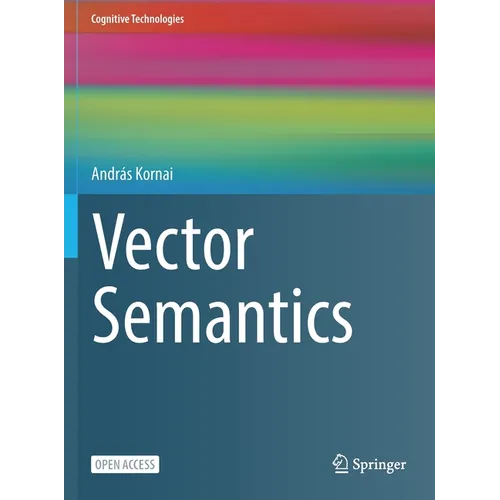
Vector Semantics - Paperback
Vector Semantics - Paperback
Couldn't load pickup availability
by András Kornai (Author)
Contents
Preface............................................................... vii
1 Foundations of non-compositionality.................................
1.1 Background ...................................................
1.2 Lexicographic principles ........................................
1.3 The syntax of definitions ........................................
1.4 The geometry of definitions......................................
1.5 The algebra of definitions .......................................
2 From morphology to syntax ........................................ 23
2.1 Lexical categories and subcategories .............................. 23
2.2 Bound morphemes ............................................. 25
2.3 Relations ..................................................... 302.4 Linking....................................................... 39
2.5 Naive grammar ................................................ 46
3 Time and space.................................................... 53
3.1 Space ........................................................ 54
3.2 Time ......................................................... 59
3.3 Indexicals, coercion ............................................ 62
3.4 Measure ...................................................... 65
4 Negation.......................................................... 69
4.1 Negation in the lexicon.......................................... 71
4.2 Quantifiers .................................................... 73
4.3 Negation in compositional constructions ........................... 74
4.4 Double negation ............................................... 77
4.5 Compositional quantifiers ....................................... 78
4.6 Disjunction ................................................... 80
4.7 Scope ambiguities.............................................. 81
4.8 Conclusions ................................................... 82
5 Valuations ........................................................ 83
5.1 Introduction ................................................... 83
5.2 The likeliness scale............................................. 84
5.3 Naive inference (likeliness update) ................................ 86
5.4 Learning...................................................... 89
5.5 Conclusions ................................................... 916 Modality ......................................................... 93
6.1 The deontic world .............................................. 93
6.2 Epistemic and autoepistemic logic ................................ 93
6.3 Defaults ...................................................... 93
7 Adjectives, gradience, implicature ................................... 95
7.1 Adjectives .................................................... 95
7.2 Gradience..................................................... 96
7.3 Implicature.................................................... 96
7.4 The elementary pieces .......................................... 97
7.5 The mechanism ................................................ 100
7.6 Memory ...................................................... 103
7.7 Conclusions ................................................... 104
8 Trainability and real-world knowledge............................... 107
8.1 Proper names.................................................. 107
8.2 Trainability ................................................... 109
9 Dynamic
Back Jacket
This open access book introduces Vector semantics, which links the formal theory of word vectors to the cognitive theory of linguistics.
The computational linguists and deep learning researchers who developed word vectors have relied primarily on the ever-increasing availability of large corpora and of computers with highly parallel GPU and TPU compute engines, and their focus is with endowing computers with natural language capabilities for practical applications such as machine translation or question answering. Cognitive linguists investigate natural language from the perspective of human cognition, the relation between language and thought, and questions about conceptual universals, relying primarily on in-depth investigation of language in use.
In spite of the fact that these two schools both have 'linguistics' in their name, so far there has been very limited communication between them, as their historical origins, data collection methods, and conceptual apparatuses are quite different. Vector semantics bridges the gap by presenting a formal theory, cast in terms of linear polytopes, that generalizes both word vectors and conceptual structures, by treating each dictionary definition as an equation, and the entire lexicon as a set of equations mutually constraining all meanings.Author Biography
András Kornai is Senior Research Advisor at SZTAKI Institute of Computer Science and full professor at the Department of Algebra, Budapest University of Technology and Economics (BME). He was educated at Eotvos Lorand University (mathematics) and Stanford (linguistics). He wrote the standard textbook Mathematical Linguistics (Springer 2007) and is past president of the Mathematics of Language SIG of ACL. He is author or co-author of over a hundred refereed publications, four monographs (the last one being Semantics, Springer 2019), and five edited volumes. He is senior member of the IEEE, winner of the ACM Distinguished Scientist award, and member of Academia Europaea.
Kornai has broad experience in industrial research (Xerox, IBM, BBN) and at startups (MAD, Calera, Belmont, Northern Light, MetaCarta, MindSpeak) working as chief scientist at the last three. Several of these startups were purchased by industry leaders (Nuance, PPD, Microsoft) and muchof the technology developed under his leadership is still in use. He held various visiting and research positions at Rice University, Boston University, and Harvard. He currently leads the SZTAKI/BME Human Language Technology group.
MindSpeak), working as chief scientist at the last three. Several of these startups were purchased by industry leaders (Nuance, PPD, Microsoft) and much of the technology developed under his leadership is still in use. He held various visiting and research positions at Rice University, Boston University, and Harvard. He currently leads the SZTAKI/BME Human Language Technology group.MindSpeak), working as chief scientist at the last three. Several of these startups were purchased by industry leaders (Nuance, PPD, Microsoft) and much of the technology developed under his leadership is still in use. He held various visiting and research positions at Rice University, Boston University, and Harvard. He currently leads the SZTAKI/BME Human Language Technology group. MindSpeak), working as chief scientist at the last three. Several of these startups were purchased by industry leaders (Nuance, PPD, Microsoft) and much of the technology developed under his leadership is still in use. He held various visiting and research positions at Rice University, Boston University, and Harvard. He currently leads the SZTAKI/BME Human Language Technology groupShare